Baby animals have a special talent for making people smile. A tiny elephant calf, fluffy bunny kit, playful puppy, or wobbly penguin chick can turn an ordinary day into a cute one.
But what do we actually call these little animals?
If you have ever wondered whether a baby goat is a kid, a baby deer is a fawn, or a baby kangaroo is a joey, you are in the right place. This huge collection of infant animal names makes learning animal vocabulary simple, fun, and memorable.
You will find common names, rare terms, adorable choices, wild animal names, farm animal names, bird names, marine animal names, and more. Some are perfect for school projects. Others are great for quizzes, trivia, writing, teaching, or simply satisfying your curiosity.
So get ready for a serious dose of animal cuteness. From tiny kits to mighty calves, these names prove that the animal kingdom has some wonderfully creative vocabulary.
Quick Comparison Table of the Best Infant Animal Names
| Name | Meaning or Wordplay | Style or Category | Best For | Why It Works |
|---|---|---|---|---|
| Calf | Young cattle and several large mammals | Classic | Farm animals | Simple and widely known |
| Cub | Young lion, tiger, bear, and others | Wild | Big cats | Short and memorable |
| Kit | Young fox or rabbit | Cute | Small mammals | Sounds playful |
| Joey | Young kangaroo or wallaby | Unique | Australian animals | Instantly recognizable |
| Fawn | Young deer | Beautiful | Woodland animals | Soft and elegant |
| Kid | Young goat | Funny | Farm animals | Familiar everyday word |
| Lamb | Young sheep | Classic | Farm animals | Warm and gentle |
| Foal | Young horse or donkey | Classic | Equines | Distinctive animal term |
| Chick | Young bird | Family-Friendly | Birds | Easy to remember |
| Gosling | Young goose | Cute | Waterfowl | Charming sound |
| Duckling | Young duck | Adorable | Birds | Instantly visual |
| Piglet | Young pig | Cute | Farm animals | Playful and familiar |
| Pup | Young dog and some other animals | Modern | Pets | Short and versatile |
| Kitten | Young cat | Classic | Pets | Universally familiar |
| Whelp | Young dog or wolf | Rare | Canines | Traditional term |
| Leveret | Young hare | Rare | Wild mammals | Unusual and memorable |
| Calf | Young elephant | Powerful | Safari animals | Fits several species |
| Chicklet | Tiny young bird | Playful | Bird lovers | Extra-cute wording |
| Eaglet | Young eagle | Bold | Birds of prey | Strong and clear |
| Tadpole | Young frog or toad | Fun | Amphibians | Highly recognizable |
| Fry | Young fish | Short | Aquatic animals | Easy vocabulary |
| Hatchling | Newly hatched animal | General | Reptiles | Describes the stage |
| Larva | Early life stage of many animals | Scientific | Biology | Useful for study |
Quick Guide Before Exploring the List
- Learn the standard term first. Common names such as calf, cub, chick, and foal are useful in school and everyday conversation.
- Check the species. One term can describe babies from several related animals, while some species have special names.
- Remember the life stage. A hatchling, larva, juvenile, and adult are not always interchangeable.
- Use unusual names for quizzes. Terms such as leveret, eyas, and fry can make excellent trivia questions.
- Group names by habitat. Farm, forest, ocean, desert, and jungle categories make memorization much easier.
- Have fun with the cute ones. Words such as piglet, duckling, kitten, and bunny are easy to remember because they sound adorable.
Popular Infant Animal Names 🐾
These are some of the best-known terms in the animal world. They are common enough to recognize quickly, yet they cover a surprisingly wide range of species.
- Calf — a young cow and also a term used for young elephants, whales, giraffes, and several other mammals.
- Cub — a young lion, tiger, bear, leopard, or other wild mammal.
- Kit — commonly used for a young fox or rabbit.
- Joey — a young kangaroo, wallaby, or related marsupial.
- Fawn — a young deer.
- Lamb — a young sheep.
- Kid — a young goat.
- Foal — a young horse, donkey, zebra, or related equine.
- Chick — a young bird.
- Puppy — a young dog.
- Kitten — a young cat.
- Piglet — a young pig.
- Duckling — a young duck.
- Gosling — a young goose.
- Calf — a young buffalo.
- Pup — a young seal, otter, fox, or other animals depending on species.
- Hatchling — a newly hatched animal, especially a reptile or bird.
- Tadpole — the early aquatic stage of a frog or toad.
- Fry — a young fish.
- Eaglet — a young eagle.
- Nestling — a young bird still living in the nest.
These familiar terms are a great starting point. Which popular infant animal name did you learn first?
Cute Infant Animal Names for Farm Animals 🐄
Farm animals provide some of the easiest and most charming baby-animal vocabulary. Many of these words are also used by children in their first animal lessons.
- Calf — young cow.
- Heifer calf — young female cattle.
- Bull calf — young male cattle.
- Lamb — young sheep.
- Kid — young goat.
- Doeling — young female goat.
- Buckling — young male goat.
- Piglet — young pig.
- Shoat — a young pig after weaning.
- Foal — young horse.
- Colt — young male horse.
- Filly — young female horse.
- Foal — young donkey.
- Calf — young water buffalo.
- Chick — young chicken.
- Pullet — young female chicken.
- Cockerel — young male chicken.
- Duckling — young duck.
- Gosling — young goose.
- Poult — young turkey.
- Keet — young guinea fowl.
Farm vocabulary becomes much easier once you connect each word to a familiar animal. Which farm animal baby name is your favorite?
Wild Mammal Infant Animal Names 🦁
Wild mammals have some of the most memorable baby-animal terms. Many sound cute, while others seem surprisingly powerful.
- Cub — young lion.
- Cub — young tiger.
- Cub — young leopard.
- Cub — young cheetah.
- Cub — young bear.
- Calf — young elephant.
- Calf — young giraffe.
- Fawn — young deer.
- Fawn — young antelope in some contexts.
- Kit — young fox.
- Pup — young wolf.
- Pup — young coyote.
- Joey — young kangaroo.
- Joey — young wallaby.
- Joey — young koala.
- Leveret — young hare.
- Bunny — informal term for a young rabbit.
- Kit — young rabbit.
- Calf — young rhinoceros.
- Calf — young hippopotamus.
- Calf — young moose.
Wild animal babies remind us that size does not determine vocabulary. A huge elephant and a tiny rabbit can both have surprisingly distinctive terms. Which wild baby animal would you most like to see?
Rare and Unique Infant Animal Names 🌿
Want vocabulary that sounds more unusual? These terms are excellent for animal trivia, educational projects, and anyone who enjoys obscure nature facts.
- Leveret — young hare.
- Eyas — young hawk, falcon, or other bird of prey still in the nest.
- Squab — young pigeon or dove.
- Cygnet — young swan.
- Gosling — young goose.
- Poult — young turkey or other young fowl.
- Keet — young guinea fowl.
- Squeaker — a young pigeon.
- Nestling — a young bird still dependent on the nest.
- Fledgling — a young bird that has begun learning to fly.
- Juvenile — a young animal that has not reached adulthood.
- Hatchling — a newly hatched animal.
- Neonate — a newborn animal.
- Larva — an immature stage in animals with particular life cycles.
- Nymph — immature stage of insects such as grasshoppers and dragonflies.
- Tadpole — immature frog or toad.
- Pollywog — another name for a tadpole.
- Fry — young fish.
- Parr — a young salmon or trout.
- Smolt — a young salmonid preparing for life in salt water.
- Elver — a young eel.
Rare terms are perfect conversation starters because they often make people say, “Wait, that is what it’s called?” Which unusual term surprised you most?
Beautiful Infant Animal Names for Birds 🐦
Bird babies have a wonderful range of names. Some describe age, while others describe their stage of development.
- Chick — general term for a young bird.
- Nestling — young bird still in the nest.
- Fledgling — young bird beginning independent flight.
- Eaglet — young eagle.
- Eyas — young bird of prey.
- Cygnet — young swan.
- Gosling — young goose.
- Duckling — young duck.
- Squab — young pigeon or dove.
- Squeaker — young pigeon.
- Poult — young turkey.
- Keet — young guinea fowl.
- Chick — young chicken.
- Pullet — young female chicken.
- Cockerel — young male chicken.
- Owlet — young owl.
- Peep — informal term for a newly hatched chick.
- Hatchling — newly hatched bird.
- Gosling — young domestic goose.
- Duckling — young domestic duck.
- Chicklet — playful informal wording for a tiny chick.
Bird vocabulary can be surprisingly specific. Which bird baby name sounds the cutest to you?
Infant Animal Names for Big Cats and Predators 🐯
Big predators may look fierce as adults, but their babies are usually described with remarkably cute words.
- Cub — young lion.
- Cub — young tiger.
- Cub — young leopard.
- Cub — young jaguar.
- Cub — young cheetah.
- Cub — young lynx.
- Cub — young cougar.
- Cub — young bobcat.
- Whelp — young wolf or dog.
- Pup — young wolf.
- Pup — young coyote.
- Pup — young fox.
- Kit — young fox.
- Kitten — young domestic cat.
- Kitten — young wild cat in informal usage.
- Calf — young hyena in some general descriptions.
- Cub — young panda.
- Cub — young raccoon.
- Cub — young red panda.
- Pup — young ferret.
- Pup — young mongoose.
“Cub” may be one of the most recognizable wild-animal baby terms. Which predator would you choose if you could safely watch one grow up?
Infant Animal Names for Marine Animals 🌊
The ocean has its own collection of fascinating baby-animal terms. Some are wonderfully familiar, while others are surprisingly broad.
- Calf — young whale.
- Calf — young dolphin.
- Calf — young seal.
- Pup — young seal.
- Pup — young sea lion.
- Pup — young walrus.
- Pup — young otter.
- Fry — young fish.
- Fingerling — young fish that has reached a small juvenile size.
- Parr — young salmon or trout.
- Smolt — young salmonid moving toward saltwater life.
- Elver — young eel.
- Hatchling — newly hatched sea turtle.
- Larva — early developmental stage of many marine animals.
- Juvenile — young animal before adulthood.
- Calf — young manatee.
- Calf — young dugong.
- Pup — young shark in common usage.
- Hatchling — newly hatched marine reptile.
- Fry — newly developing young fish.
- Juvenile — young marine mammal or fish.
Ocean babies can look completely different from adults. Which marine baby animal would you love to see in the wild?
Infant Animal Names for Reptiles and Amphibians 🐸
Reptiles and amphibians can change dramatically as they grow. Their vocabulary reflects those fascinating life stages.
- Hatchling — newly hatched turtle.
- Hatchling — newly hatched tortoise.
- Hatchling — newly hatched crocodile.
- Hatchling — newly hatched alligator.
- Hatchling — newly hatched snake.
- Hatchling — newly hatched lizard.
- Tadpole — young frog.
- Tadpole — young toad.
- Pollywog — another term for tadpole.
- Tadpole — early aquatic salamander stage in some contexts.
- Larva — immature amphibian stage.
- Juvenile — young reptile.
- Juvenile — young amphibian.
- Froglet — young frog after metamorphosis begins.
- Toadlet — young toad.
- Newtlet — informal term for a young newt.
- Hatchling — baby gecko.
- Hatchling — baby chameleon.
- Hatchling — baby iguana.
- Hatchling — baby monitor lizard.
- Hatchling — baby sea turtle.
The biggest lesson here is simple: not every baby reptile or amphibian has a special nickname. Sometimes “hatchling” or “juvenile” is the most useful term. Which tiny reptile or amphibian is your favorite?
Infant Animal Names for Insects and Small Creatures 🦋
Small creatures have some of the most interesting developmental names. Their babies may look nothing like the adults.
- Larva — immature stage of many insects.
- Caterpillar — larval stage of a butterfly or moth.
- Nymph — immature grasshopper.
- Nymph — immature cricket.
- Nymph — immature dragonfly.
- Nymph — immature cockroach.
- Grub — larval beetle.
- Maggot — larva of a fly.
- Mealworm — larval darkling beetle.
- Caterpillar — young moth.
- Caterpillar — young butterfly.
- Larva — young mosquito.
- Larva — young ant before pupation.
- Larva — young bee.
- Larva — young wasp.
- Larva — young beetle.
- Nymph — immature aphid.
- Nymph — immature termite.
- Nymph — immature mantis.
- Hatchling — newly emerged insect.
- Pupa — developmental stage between larva and adult in complete metamorphosis.
These names show why insects are so fascinating. Which insect life stage would you most like to study?
Classic Infant Animal Names for Kids and Families 👨👩👧
If you need simple terms for children, classrooms, worksheets, or family learning, start here.
- Puppy — baby dog.
- Kitten — baby cat.
- Bunny — informal baby rabbit.
- Lamb — baby sheep.
- Kid — baby goat.
- Calf — baby cow.
- Piglet — baby pig.
- Foal — baby horse.
- Chick — baby bird.
- Duckling — baby duck.
- Gosling — baby goose.
- Joey — baby kangaroo.
- Cub — baby bear.
- Fawn — baby deer.
- Kit — baby fox.
- Tadpole — baby frog in its early stage.
- Hatchling — newly hatched turtle.
- Eaglet — baby eagle.
- Cygnet — baby swan.
- Calf — baby dolphin.
- Pup — baby seal.
These are easy to teach because the words are short, vivid, and connected to animals children already know. Which one would you put on a first animal-word worksheet?
Funny and Playful Infant Animal Names 😂
Some animal baby terms are naturally funny because the words have meanings outside the animal world.
- Kid — a young goat and also a child.
- Joey — a baby kangaroo with a human-style first name.
- Pup — a tiny baby animal with a very short name.
- Kit — a young fox or rabbit and also a common English word.
- Calf — a word shared by cattle and several huge mammals.
- Cub — a tiny term for babies of enormous predators.
- Fry — a young fish with a name that sounds like cooking.
- Shoat — a young pig with an unusual sound.
- Leveret — a baby hare with an elegant old-fashioned name.
- Eyas — a rare word that sounds like a fantasy character.
- Cygnet — a baby swan with a surprisingly sophisticated name.
- Squab — a baby pigeon with a funny-sounding word.
- Keet — a tiny guinea-fowl baby name.
- Poult — a young turkey with an unusual name.
- Elver — a young eel that sounds like a tiny fantasy creature.
- Tadpole — a classic funny word for a baby frog.
- Pollywog — a playful word for tadpole.
- Grub — an insect larva with a word also used for food.
- Maggot — a fly larva with a memorable name.
- Nymph — a young insect with a word rooted in mythology.
- Whelp — a traditional term for young dogs and wolves.
Funny words are easier to remember because they create a mental picture. Which infant animal name made you laugh?
Beautiful and Nature-Inspired Infant Animal Names 🌸
Some baby-animal names sound gentle, poetic, or closely connected to nature.
- Fawn — soft and graceful young deer.
- Cygnet — elegant young swan.
- Lamb — gentle young sheep.
- Fledgling — young bird beginning independence.
- Nestling — young bird in the nest.
- Eaglet — young eagle.
- Calf — young elephant.
- Joey — young kangaroo.
- Kit — young fox.
- Leveret — young hare.
- Cub — young bear.
- Gosling — young goose.
- Duckling — young duck.
- Foal — young horse.
- Colt — young male horse.
- Filly — young female horse.
- Lambkin — affectionate term for a little lamb.
- Fawnlet — playful descriptive wording for a tiny fawn.
- Owlet — young owl.
- Chick — young bird.
- Hatchling — newly hatched young animal.
Nature-inspired terms work beautifully in stories, poems, classroom materials, and creative projects. Which one sounds the most magical?
Modern and Easy Infant Animal Names 📚
These terms are especially useful when you want vocabulary that is easy to understand and remember.
- Baby animal — broad everyday description.
- Youngling — general informal term for a young animal.
- Juvenile — scientific term for a young animal.
- Neonate — newborn animal.
- Hatchling — newly hatched animal.
- Chick — young bird.
- Pup — young dog and various mammals.
- Cub — young wild mammal.
- Calf — young cattle and many large mammals.
- Kit — young fox or rabbit.
- Joey — young marsupial.
- Fawn — young deer.
- Foal — young horse.
- Lamb — young sheep.
- Kid — young goat.
- Piglet — young pig.
- Kitten — young cat.
- Puppy — young dog.
- Duckling — young duck.
- Gosling — young goose.
- Tadpole — early frog or toad stage.
If you are teaching beginners, these words are a strong foundation. Which term would you teach first?
Infant Animal Names by Life Stage 🔬
Not all animal babies are simply called “babies.” Biology often uses special terms for different stages of growth.
- Neonate — a newborn animal.
- Juvenile — an immature animal.
- Hatchling — an animal that has recently hatched.
- Nestling — a young bird still dependent on its nest.
- Fledgling — a young bird that has recently left or is leaving the nest.
- Larva — an immature form in many insects and other animals.
- Nymph — immature insect stage without a pupal stage.
- Pupa — transitional stage in insects with complete metamorphosis.
- Tadpole — early frog or toad stage.
- Pollywog — alternative term for tadpole.
- Fry — young fish.
- Fingerling — small juvenile fish.
- Parr — young freshwater salmonid.
- Smolt — salmonid preparing for migration to salt water.
- Elver — young eel.
- Grub — larval beetle.
- Maggot — fly larva.
- Caterpillar — butterfly or moth larva.
- Leveret — young hare.
- Eyas — young bird of prey.
- Squab — young pigeon or dove.
Understanding life stages makes animal vocabulary much easier because the terms describe what the animal is doing and how it is developing. Which life-stage term was new to you?
Cool and Memorable Infant Animal Names ⭐
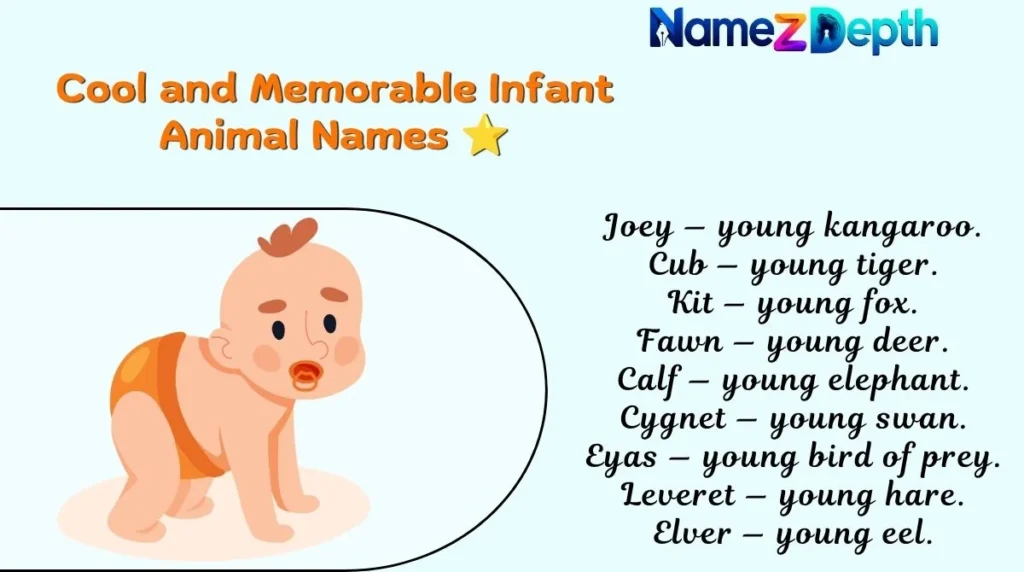
Some terms simply stick in your head. They are short, distinctive, or linked to animals people find fascinating.
- Joey — young kangaroo.
- Cub — young tiger.
- Kit — young fox.
- Fawn — young deer.
- Calf — young elephant.
- Cygnet — young swan.
- Eyas — young bird of prey.
- Leveret — young hare.
- Elver — young eel.
- Smolt — young salmonid.
- Parr — young salmon or trout.
- Squab — young pigeon.
- Keet — young guinea fowl.
- Poult — young turkey.
- Whelp — young wolf or dog.
- Pup — young seal.
- Owlet — young owl.
- Eaglet — young eagle.
- Hatchling — newly hatched reptile.
- Tadpole — young frog.
- Fledgling — young bird learning independence.
Cool vocabulary does not have to be complicated. Often, the strangest little word is the one people remember. Which name deserves a spot in your favorite-animal vocabulary?
How We Selected These Infant Animal Names
Creating a useful list of infant animal names is more than collecting random words. The goal is to make the list accurate, varied, easy to understand, and useful for different readers.
1. We started with widely recognized names
Words such as calf, cub, chick, lamb, kid, foal, puppy, and kitten are important because they form the foundation of basic animal vocabulary.
These are the terms most readers are likely to encounter first.
2. We added species-specific vocabulary
Some animals have more distinctive terms. Kangaroos have joeys, swans have cygnets, hares have leverets, and birds of prey may have eyases.
These words add depth to the list.
3. We included scientific life stages
Animal development does not always fit into a simple “baby” category. Terms such as larva, nymph, pupa, juvenile, hatchling, and neonate can describe specific stages.
This makes the collection useful for students and curious readers.
4. We covered different animal groups
A strong vocabulary guide should not focus only on farm animals. That is why the list includes mammals, birds, reptiles, amphibians, fish, insects, and marine animals.
5. We prioritized easy explanations
Every name should be understandable without a biology degree. Complex terminology is explained in plain English.
6. We avoided unnecessary repetition
Some terms genuinely apply to multiple species. Where possible, the article uses categories and examples to show that relationship instead of pretending every animal has a completely unique word.
7. We included both everyday and unusual terms
Everyday terms help beginners. Rare terms make the list more interesting.
That balance gives readers something useful whether they are studying for a quiz, teaching children, writing a story, or simply exploring animal facts.
Tips for Choosing the Perfect Infant Animal Name
If you are choosing names for a school project, story, worksheet, trivia game, or educational activity, these tips can help.
Choose accuracy over cleverness
A funny word is great, but make sure it actually belongs to the animal you are describing.
For example, joey is strongly associated with kangaroos and other marsupials, while calf applies to many different mammals.
Think about the animal group
Ask whether your animal is a mammal, bird, fish, reptile, amphibian, or insect. That first step often narrows the vocabulary quickly.
Remember that one term may cover many species
Animal vocabulary is not always one-to-one. “Cub” can refer to young members of several wild mammal species.
Use simple terms with young learners
For children, start with familiar words such as:
- Puppy
- Kitten
- Lamb
- Calf
- Chick
- Duckling
- Piglet
- Kid
- Fawn
- Cub
Then introduce rarer words once the basics are comfortable.
Use rare terms for trivia
If you want a difficult quiz question, eyas, leveret, squab, elver, and smolt are excellent choices.
Match the word to the context
A scientific report may prefer juvenile or neonate, while a children’s story may sound better with little cub or tiny duckling.
Make learning visual
Pairing each term with a picture can make memorization much easier, especially for young students.
Turn vocabulary into a game
Ask questions such as:
“What is a baby swan called?”
“What is a baby kangaroo called?”
“What is a young hare called?”
The answers—cygnet, joey, and leveret—become much easier to remember when presented as a challenge.
FAQs
What are the most common infant animal names?
Some of the most familiar terms include calf, cub, chick, puppy, kitten, lamb, kid, foal, piglet, duckling, gosling, fawn, and joey. These are excellent starting points for learning animal vocabulary.
What is a baby animal called in general?
There is no single special word for every baby animal. “Baby animal,” “young animal,” “juvenile,” and “youngling” can be used generally, depending on the context.
What is a baby kangaroo called?
A baby kangaroo is called a joey. The same term is also used for the young of several other marsupials, including wallabies and some related animals.
What is a baby deer called?
A young deer is called a fawn. The word is one of the best-known and most distinctive examples of infant animal vocabulary.
What are some rare infant animal names?
Rare or less familiar terms include leveret for a young hare, eyas for a young bird of prey, squab for a young pigeon or dove, elver for a young eel, and smolt for a young salmonid preparing for marine life.
Why do different animals have different baby names?
Animal names developed through everyday language, farming, hunting, wildlife observation, and scientific study. Some terms became widely established over centuries, while others remain specialized or regional.
Conclusion
The animal kingdom has an incredible vocabulary for its youngest members. From a tiny kit hiding in the grass to a calf learning to walk, these words help us describe the earliest and often most adorable stages of animal life.
You now have a wide collection of infant animal names, including familiar choices such as puppy, kitten, lamb, chick, cub, fawn, kid, and foal, along with fascinating terms such as leveret, eyas, squab, elver, smolt, and cygnet.
The best way to remember them is to connect each word with a picture, animal, habitat, or story. Learn a few at a time, quiz yourself, and have fun with the unusual ones.
Whether you are building a classroom lesson, writing a children’s story, preparing for a trivia quiz, or simply wondering what that adorable little creature is called, there is always another animal term to discover.
Which infant animal name is your favorite? Share it with someone who loves animals, and see how many they already know! 🐾❤️